Search is changing. Google AI Overviews, ChatGPT with web search, and Perplexity are answering user questions directly — often without the user clicking through to any website. If your content isn't being cited by these AI engines, you're losing visibility in a growing channel.
This is where GEO (Generative Engine Optimization) comes in.
GEO vs. Traditional SEO
Traditional SEO focuses on ranking in a list of blue links. GEO focuses on getting your content cited as a source in AI-generated answers.
| Traditional SEO | GEO | |
|---|---|---|
| Goal | Rank on page 1 | Be cited in AI answers |
| Surface | Blue links, featured snippets | AI Overviews, ChatGPT, Perplexity |
| Signal | Backlinks, keywords, site authority | Citability, clarity, authority signals |
| Click model | User clicks your listing | User sees your brand in the AI response, may click the citation |
| Content format | Optimized for scanning | Optimized for extraction |
GEO doesn't replace SEO — it builds on it. A site with strong SEO fundamentals already has an advantage in GEO. But there are specific optimizations that make your content more likely to be picked up by AI engines.
Why GEO Matters Now
AI Search Is Growing Fast
Google AI Overviews now appear in a significant percentage of search queries. ChatGPT's web search feature has hundreds of millions of users. Perplexity is growing rapidly as a research tool. These aren't fringe products — they're becoming how people find information.
Zero-Click Is the New Normal
When an AI engine answers a question directly, many users never click through. But the sources cited in that answer still get brand visibility — and the users who do click through tend to be highly engaged.
Early Mover Advantage
Most websites haven't optimized for GEO yet. The sites that start now will build a compounding advantage as AI search usage grows.
How AI Engines Select Sources
AI search engines don't just pick random pages. They look for content that is:
- Authoritative — Strong E-E-A-T signals (experience, expertise, authoritativeness, trustworthiness)
- Clearly structured — Well-organized with headings, lists, and tables that are easy to extract
- Factually specific — Contains concrete data, statistics, and definitive statements rather than vague generalities
- Citable at the passage level — Individual paragraphs or sections that can stand alone as a source for a specific claim
- Accessible to AI crawlers — Not blocked by robots.txt or requiring JavaScript rendering
Key GEO Optimization Strategies
1. Write Citable Passages
AI engines cite content at the passage level, not the page level. Each section of your content should be able to stand alone as a clear, authoritative answer to a specific question.
Weak (not citable):
SEO audits are really important and you should probably do one sometime.
Strong (citable):
An SEO audit examines a website's technical health, on-page optimization, and content quality to identify issues that prevent search engines from properly crawling, indexing, and ranking the site.
2. Use Structured Formatting
AI engines prefer content that's easy to parse:
- Headings that clearly describe what follows
- Tables for comparisons and data
- Numbered lists for processes and steps
- Definition patterns — "X is Y" statements at the start of sections
- Bold key terms to signal important concepts
3. Include Specific Data and Statistics
Vague content doesn't get cited. Specific, quantifiable claims do:
- Include numbers, percentages, and benchmarks
- Cite your own data or research when possible
- Provide concrete examples rather than abstract advice
4. Ensure AI Crawler Access
Several AI companies use web crawlers to index content:
| Crawler | Company | Purpose |
|---|---|---|
| GPTBot | OpenAI | Training data and search |
| ClaudeBot | Anthropic | Training data |
| PerplexityBot | Perplexity | Real-time search |
| Google-Extended | AI features including AI Overviews |
Check your robots.txt to ensure you're not blocking these crawlers. Blocking them means your content won't appear in their AI-generated answers.
5. Add llms.txt
llms.txt is an emerging standard (similar to robots.txt) that helps AI systems understand your site. It provides a structured overview of your site's purpose, key pages, and content organization.
6. Strengthen Brand Mention Signals
AI engines are more likely to cite sources they've seen mentioned frequently across the web. Build brand mentions through:
- Industry publications and guest posts
- Social media presence and discussions
- Community participation (forums, Q&A sites)
- Press coverage and partnerships
How to Measure GEO Performance
Unlike traditional SEO where you can track rankings in Search Console, GEO measurement is still evolving. Key approaches:
- Monitor AI Overviews — Check if your site appears as a cited source for target queries
- Track referral traffic — Watch for traffic from ChatGPT, Perplexity, and AI-powered search
- Audit citability — Score your content's readiness to be cited at the passage level
- Check crawler access — Verify AI crawlers can reach your content
GEO Audit with Kaitico
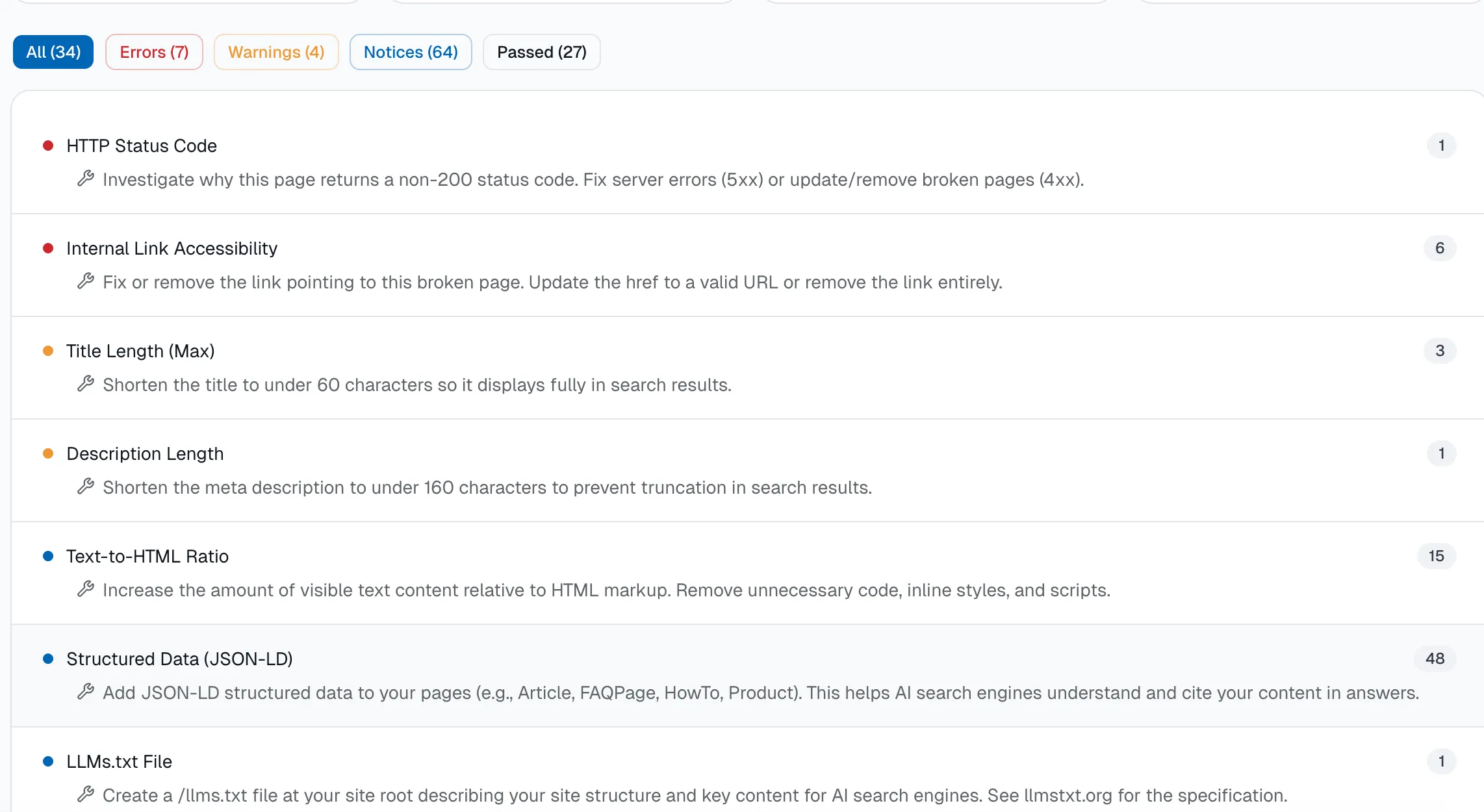
Kaitico now includes GEO analysis as part of its SEO audit. When you run an audit, we check:
- AI crawler accessibility — Whether GPTBot, ClaudeBot, and PerplexityBot can access your pages
- llms.txt compliance — Whether your site has a properly formatted llms.txt file
- Brand mention signals — External visibility indicators for your domain
- Passage-level citability — How well your content is structured for AI citation
- Content extractability — Whether your key information can be cleanly extracted by AI engines
These checks help you understand where you stand and what to fix to improve your visibility in AI-powered search.
Getting Started
GEO doesn't require a complete content overhaul. Start with these high-impact steps:
- Audit your robots.txt — Make sure you're not blocking AI crawlers
- Review your top pages — Rewrite key sections to be more citable (specific, structured, authoritative)
- Add structured data — Schema markup helps AI engines understand your content
- Create an llms.txt file — Guide AI systems to your most important content
- Run a GEO audit — Use Kaitico to get a baseline score and prioritized recommendations
The sites that optimize for AI search now will be the ones cited when your potential customers ask AI for recommendations. Don't wait until your competitors are already there.